Emblems
How Circular Frames Organize a Composition
A fixed ring concentrates attention, establishes rhythm and changes how a central figure meets the page.
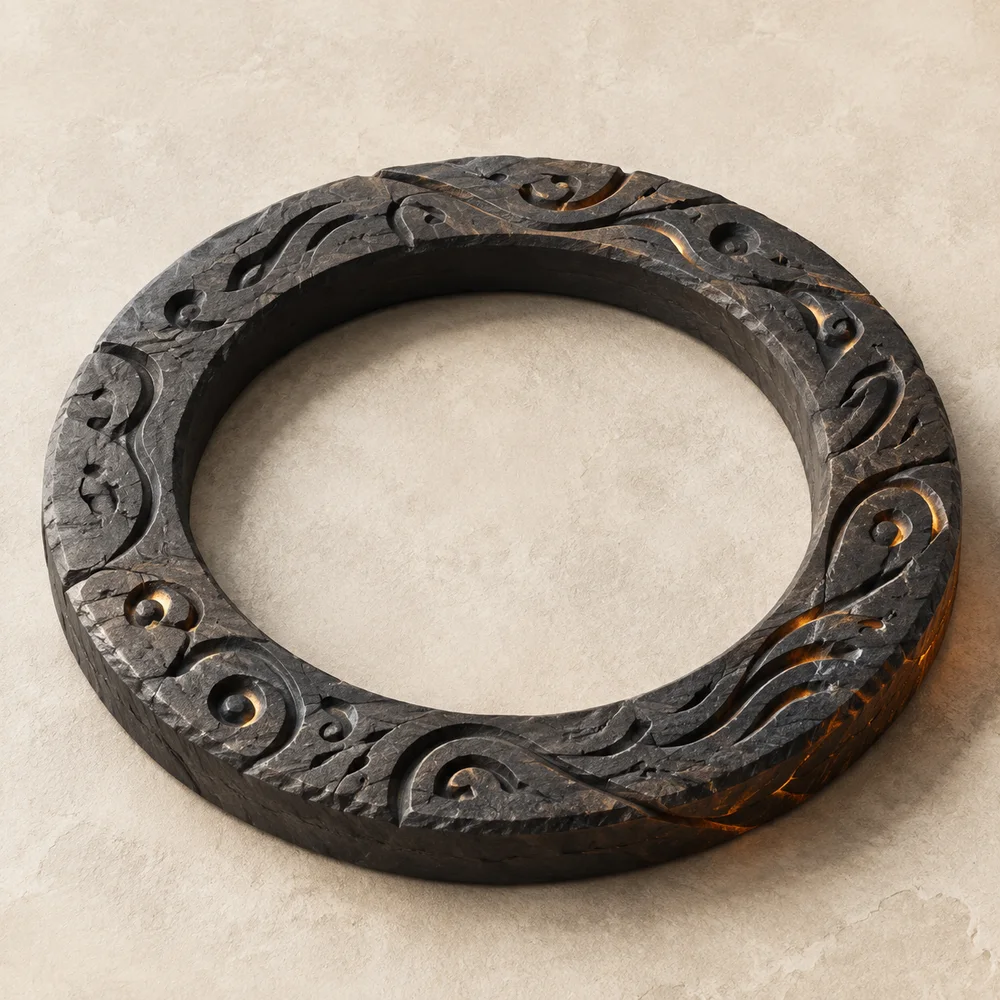
A circle is both boundary and route. It can isolate a figure from its surroundings while guiding the eye around an unbroken edge. In an emblem-like illustration, the frame is not neutral packaging: thickness, texture, interruption and spacing all influence how the central subject is read.
Name the form precisely
Getty’s Art & Architecture Thesaurus uses “roundel” for a circular panel, usually sculpted or otherwise decorated, set in an architectural context. It directs two-dimensional decorative motifs toward related medallion terminology. Such controlled vocabulary helps describe documented objects without assuming their purpose.
The Emblem & Fire images are not architectural roundels. They are digital compositions that use a roundel-like boundary. This distinction matters: formal resemblance supports a design comparison, but it does not establish material, date, function or provenance.
Control the visual pressure
A tight ring makes wings feel as if they are pressing against the edge; a wider inner margin gives the bird a calmer, icon-like presence. Cropping feather tips can suggest energy, while keeping the silhouette fully inside the frame emphasizes containment and balance.
Frame thickness also changes hierarchy. A heavy dark border competes with the subject unless the center carries enough light or detail. A thin border reads more as a line than an object. Test the composition at thumbnail size: the central figure and boundary should remain distinct.
Use ornament as rhythm
Repeated grooves and notches can slow the eye as it travels around the ring. Uneven spacing introduces tension; regular spacing produces a measured cadence. Neither pattern needs a secret message to be visually effective.
In our carved-symbols study, the marks are fictional decorative grooves. We do not call them runes, translate them or connect them to a culture. An authentic inscription would require legible documentation, language expertise, provenance and a source record—not a guess based on angular shapes.
Keep the frame still
The circular boundary here is a stationary editorial device. It has no pointer, sectors, controls or changing state. Its purpose is to focus a reading of material and figure. Motion, if suggested, comes from feather direction and light rather than from the ring itself.
For page layout, echo the circle sparingly. One rounded image crop or small copper dot can connect the interface to the subject. Repeating concentric circles behind every card would weaken the central motif and make a quiet journal feel like an interface simulation.
Working takeaway
Use the circle as a fixed compositional boundary, and describe historical roundels only when the object record supports that term.
Sources and scope
These references support the historical and terminological framework. They do not endorse this publication or its illustrations.
- Getty Research InstituteArt & Architecture Thesaurus: roundels
Terminology for circular decorative panels in architectural settings.
- National Gallery of ArtThe Elements of Art: Symbolism and Place
Introductory framework for distinguishing a visible form from the idea assigned to it.